Semantic elements = elements with a meaning.
What are Semantic Elements?
A semantic element clearly describes its meaning to both the browser and the developer.
Examples of non-semantic elements: <div> and <span> - Tells nothing about its content.
Examples of semantic elements: <img>, <table>, and <article> - Clearly defines its content.
Semantic Elements in HTML
Many web sites contain HTML code like:
In HTML there are several semantic elements that can be used to define different parts of a web page:
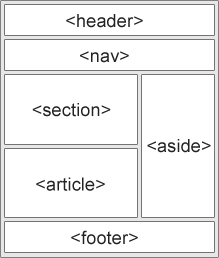
HTML Element
The <section> element defines a section in a document.
According to W3C's HTML documentation: "A section is a thematic grouping of content, typically with a heading."
Examples of where a <section> element can be used:
- Chapters
- Introduction
- News items
- Contact information
A web page could normally be split into sections for introduction, content, and contact information.
Example
    <section>
<h1>WWF</h1>
<p>The World Wide Fund for Nature (WWF) is an
    international organization working on issues regarding the conservation,
    research and restoration of the environment, formerly named the World
    Wildlife Fund. WWF was founded in 1961.</p>
</section>

<section>

    <h1>WWF's Panda symbol</h1>
<p>The Panda has become the symbol of WWF.
    The well-known panda logo of WWF originated from a panda named Chi Chi that
    was transferred from the Beijing Zoo to the London Zoo in the same year of
    the establishment of WWF.</p>
</section>
HTML Element
The <article> element specifies independent, self-contained content.
An article should make sense on its own, and it should be possible to distribute it independently from the rest of the web site.
Examples of where the <article> element can be used:
- Forum posts
- Blog posts
- User comments
- Product cards
- Newspaper articles
Example
    <article>
<h2>Google Chrome</h2>
<p>Google Chrome is a web browser
    developed by Google, released in 2008. Chrome is the world's most popular
    web browser today!</p>
</article>

<article>
<h2>Mozilla
    Firefox</h2>
<p>Mozilla Firefox is an open-source web browser developed
    by Mozilla. Firefox has been the second most popular web browser since
    January, 2018.</p>
</article>

<article>
<h2>Microsoft Edge</h2>

    <p>Microsoft Edge is a web browser developed by Microsoft, released in 2015.
    Microsoft Edge replaced Internet Explorer.</p>
</article>
Example 2
  <html>
<head>
<style>
.all-browsers {
  margin: 0;

  padding: 5px;
  background-color: lightgray;
}

.all-browsers
  > h1, .browser {
  margin: 10px;
  padding: 5px;
}

  .browser {
  background: white;
}

.browser > h2,
  p {
  margin: 4px;
  font-size: 90%;
}
</style>

  </head>
<body>

<article class="all-browsers">
  <h1>Most
  Popular Browsers</h1>
  <article class="browser">

  <h2>Google Chrome</h2>
    <p>Google Chrome is a web browser
  developed by Google, released in 2008. Chrome is the world's most popular web
  browser today!</p>
  </article>
  <article class="browser">

  <h2>Mozilla Firefox</h2>
    <p>Mozilla Firefox is an
  open-source web browser developed by Mozilla. Firefox has been the second most
  popular web browser since January, 2018.</p>
  </article>

  <article class="browser">
    <h2>Microsoft Edge</h2>

  <p>Microsoft Edge is a web browser developed by Microsoft, released in 2015.
  Microsoft Edge replaced Internet Explorer.</p>
  </article>

  </article>

</body>
</html>
Nesting in or Vice Versa?
The <article> element specifies independent, self-contained content.
The <section> element defines a section in a document.
Can we use the definitions to decide how to nest those elements? No, we cannot!
So, you will find HTML pages with <section> elements containing <article> elements, and <article> elements containing <section> elements.
HTML Element
The <header> element represents a container for introductory content or a set of navigational links.
A <header> element typically contains:
- one or more heading elements (
-
)
- logo or icon
- authorship information
Note: You can have several <header> elements in one HTML document. However, <header> cannot be placed within a <footer>, <address> or another <header> element.
Example
   <article>

 <header>

<h1>What Does WWF Do?</h1>

   <p>WWF's mission:</p>

 </header>

  <p>WWF's mission is to stop the degradation of our planet's natural environment,
 and build a future in which humans live in harmony with nature.</p>

</article>
HTML
The <footer> element defines a footer for a document or section.
A <footer> element typically contains:
- authorship information
- copyright information
- contact information
- sitemap
- back to top links
- related documents
You can have several <footer> elements in one document.
Example
   <footer>

 <p>Author: Hege Refsnes</p>

 <p><a href="mailto:hege@example.com">hege@example.com</a></p>

</footer>
HTML
The <nav> element defines a set of navigation links.
Note: Notice that NOT all links of a document should be inside a
<nav>element. The<nav>element is intended only for major blocks of navigation links. Browsers, such as screen readers for disabled users, can use this element to determine whether to omit the initial rendering of this content.
Example
   <nav>

<a href="/html/">HTML</a> |

<a href="/css/">CSS</a> |

<a href="/js/">JavaScript</a> |

<a href="/jquery/">jQuery</a>

</nav>
HTML
The <aside> element defines some content aside from the content it is placed in (like a sidebar).
The <aside> content should be indirectly related to the surrounding content.
Example
    <p>My family and I visited The Epcot center this summer. The weather was
    nice, and Epcot was amazing! I had a great summer together with my
    family!</p>

<aside>
<h4>Epcot Center</h4>
<p>Epcot is a theme
    park at Walt Disney World Resort featuring exciting attractions,
    international pavilions, award-winning fireworks and seasonal special
    events.</p>
</aside>
Example 2
  <html>
<head>
<style>
aside {
  width: 30%;

  padding-left: 15px;
  margin-left: 15px;
  float: right;

  font-style: italic;
  background-color: lightgray;
}
</style>
</head>
<body>

<p>My family and I visited The Epcot
  center this summer. The weather was nice, and Epcot was amazing! I had a great
  summer together with my family!</p>

<aside>
<p>The Epcot center is a
  theme park at Walt Disney World Resort featuring exciting attractions,
  international pavilions, award-winning fireworks and seasonal special
  events.</p>
</aside>

<p>My family and I visited The Epcot center
  this summer. The weather was nice, and Epcot was amazing! I had a great summer
  together with my family!</p>
<p>My family and I visited The Epcot center
  this summer. The weather was nice, and Epcot was amazing! I had a great summer
  together with my family!</p>

</body>
</html>
HTML and Elements
The <figure> tag specifies self-contained content, like illustrations, diagrams, photos, code listings, etc.
The <figcaption> tag defines a caption for a <figure> element. The <figcaption> element can be placed as the first or as the last child of a <figure> element.
The <img> element defines the actual image/illustration.
Example
<figure>

  <img src="pic_trulli.jpg" alt="Trulli">

  <figcaption>Fig1. - Trulli, Puglia, Italy.</figcaption>

</figure>
Why Semantic Elements?
According to the W3C: "A semantic Web allows data to be shared and reused across applications, enterprises, and communities."
Semantic Elements in HTML
Below is a list of some of the semantic elements in HTML.
| Tag | Description |
|---|---|
| Defines independent, self-contained content | |
| Defines content aside from the page content | |
| Defines additional details that the user can view or hide | |
| Defines a caption for a |
|
| Specifies self-contained content, like illustrations, diagrams, photos, code listings, etc. | |
| Defines a footer for a document or section | |
| Specifies a header for a document or section | |
| Specifies the main content of a document | |
| Defines marked/highlighted text | |
| Defines navigation links | |
| Defines a section in a document | |
| Defines a visible heading for a element |
|
| Defines a date/time |
Note: For a complete list of all available HTML tags, visit our HTML Tag Reference.
Want to go beyond the notes?
Join Coding Now Tech Institute's HTML course — live mentorship, real projects, and 100% placement support.
Enroll Now — Free Demo AvailableHTML Semantics – FAQs
Quick answers about learning HTML Semantics in HTML.