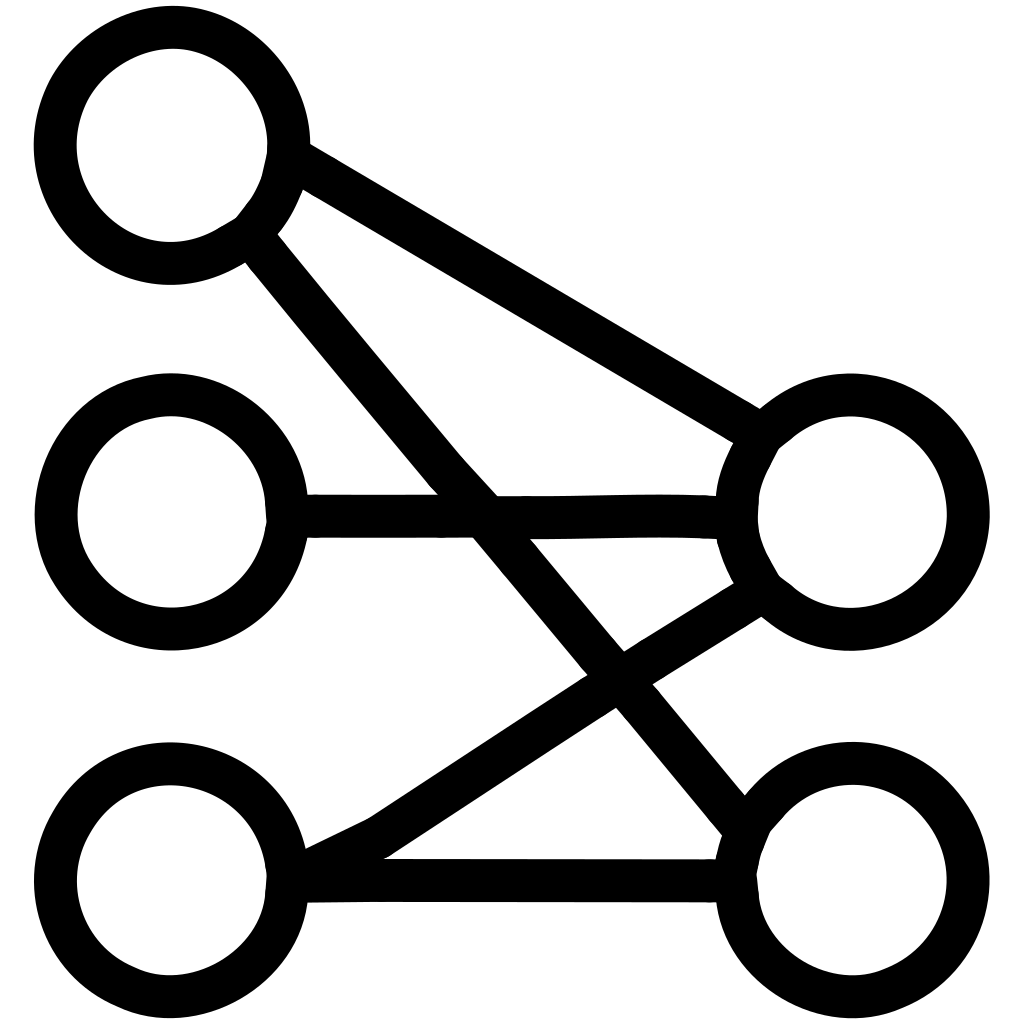
DenseNet pushes ResNet's skip-connection idea even further: instead of connecting each block only to the one before it, every layer connects directly to every subsequent layer within a block — maximizing feature reuse throughout the network.
The Problem It Solved
ResNet's residual connections help gradients flow, but each layer still only receives its immediate predecessor's output directly. DenseNet asked: what if every layer had direct access to every earlier layer's feature maps, not just the one right before it — maximizing the reuse of already-computed features and further strengthening gradient flow?
Key Innovation: Dense Connections via Concatenation
Layer \(l\)'s input is the concatenation of every previous layer's output within that dense block — not addition, the way ResNet combines its skip connection (this is the same concatenation-vs-addition distinction as Inception Network). Each layer's own output is typically a fairly small number of new channels (called the "growth rate"), added to the ever-growing concatenated pool that every subsequent layer can draw from.
Diagram
Every layer receives, as input, the concatenation of every previous layer's output — maximizing direct feature reuse throughout the block.
Advantages and Limitations
| Advantages | Limitations |
|---|---|
| Strong gradient flow — every layer has a direct path to the loss and to every earlier layer | Memory-intensive — concatenating many layers' feature maps requires keeping all of them in memory simultaneously |
| Fewer total parameters than a comparably deep ResNet, thanks to aggressive feature reuse rather than re-learning similar features repeatedly | Feature-map concatenation grows with depth, increasing compute for later layers within a dense block |
Code — A Simplified Dense Layer
import torch
import torch.nn as nn

class DenseLayer(nn.Module):
    def __init__(self, in_channels, growth_rate):
        super().__init__()
        self.conv = nn.Conv2d(in_channels, growth_rate, kernel_size=3, padding=1)

    def forward(self, x):
        new_features = torch.relu(self.conv(x))
        return torch.cat([x, new_features], dim=1)   # concatenate, growing the channel count
Use Cases
DenseNet remains a strong choice specifically when parameter efficiency matters (achieving strong accuracy with fewer total parameters than a comparably deep ResNet), though its memory overhead from feature concatenation is a real practical tradeoff to weigh against that parameter efficiency.
Common Mistakes
- Assuming DenseNet's fewer parameters automatically means lower memory usage overall — concatenating many layers' feature maps for dense connectivity can actually increase memory consumption during training, despite the parameter count itself being smaller.
Interview Relevance
Q: "How does DenseNet's connectivity differ from ResNet's, and what does that buy you?" ResNet adds a block's input to its own output (a single skip connection per block); DenseNet concatenates every previous layer's output as the input to each subsequent layer within a block, maximizing direct feature reuse and gradient flow throughout. This tends to produce a more parameter-efficient network for comparable accuracy, at the cost of higher memory usage from keeping many concatenated feature maps around simultaneously.
Practice Question
Why does DenseNet use concatenation rather than addition to combine features across layers, unlike ResNet?
