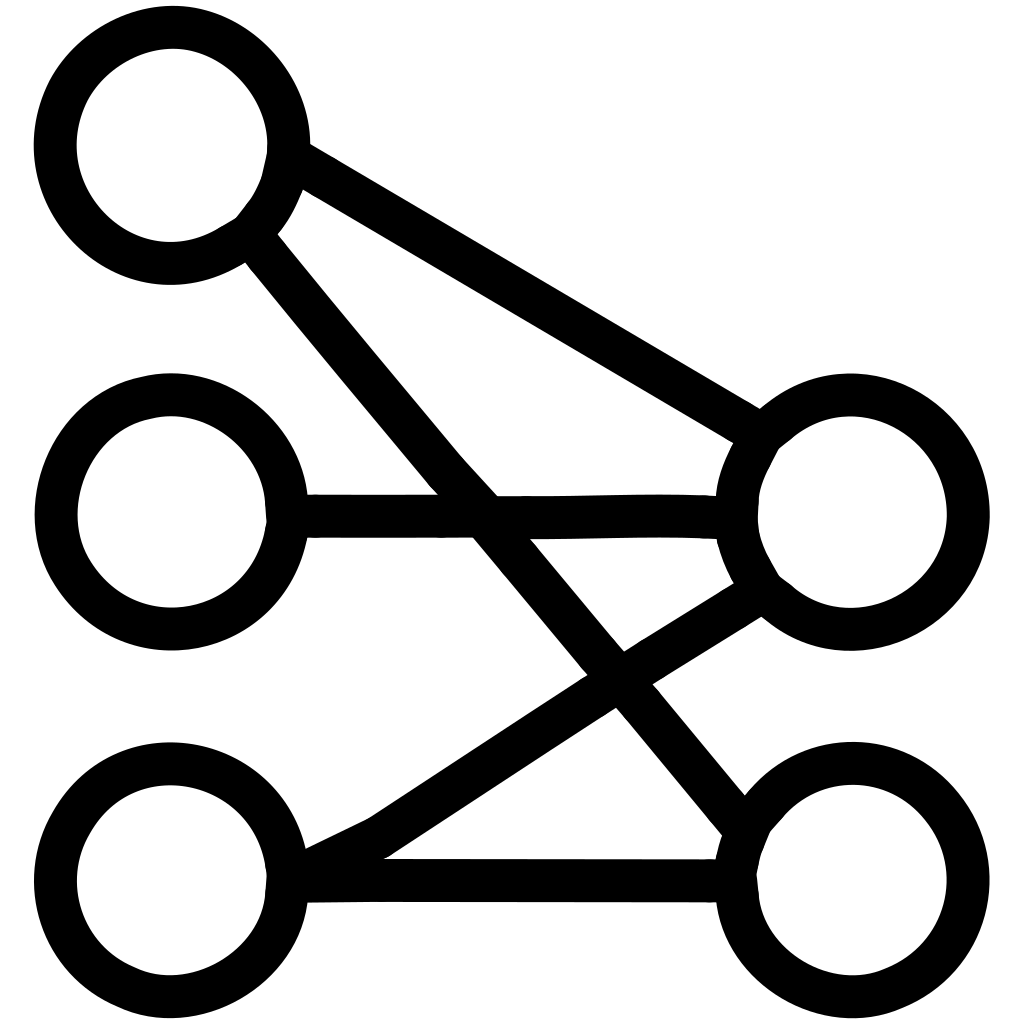
This closing note of the Self-Supervised Learning category names the overarching goal every technique covered so far actually serves: representation learning — producing general-purpose, reusable representations of data, independent of any single specific task.
The Unifying Goal
Every pretext task, every contrastive framework, every masked-modeling approach in this category shares the same ultimate purpose: learn an encoder that maps raw data (images, text) into a representation space where semantically meaningful structure is captured — such that this representation is genuinely useful across many different downstream tasks, not narrowly specialized to just one.
How Representation Quality Is Actually Evaluated
| Evaluation Method | What It Measures |
|---|---|
| Linear probing | Freeze the pretrained encoder entirely, train only a single linear classifier on top (exactly the feature extraction pattern from Feature Extraction) — measures how well-separated the learned representations already are, with no further adaptation |
| Fine-tuning evaluation | Allow the encoder itself to be further adapted on the downstream task — measures the representation's value as a strong starting point, even if not perfectly suited out of the box |
| Transfer across multiple, diverse downstream tasks | The strongest evidence of genuinely general-purpose representations — strong performance across many different tasks, not just one |
Linear probing specifically is the standard, widely-used benchmark for comparing self-supervised methods, precisely because it isolates the quality of the frozen representation itself, without letting further fine-tuning mask weaknesses in what was actually learned during pretraining.
Code — A Linear Probe Evaluation
import torch
import torch.nn as nn

pretrained_encoder = load_self_supervised_encoder()   # e.g. from SimCLR or MAE pretraining
for param in pretrained_encoder.parameters():
    param.requires_grad = False   # completely frozen -- exactly feature extraction

linear_probe = nn.Linear(feature_dim, num_classes)   # ONLY this is trained

# Training accuracy of this simple linear probe, on top of FROZEN features,
# is the standard way self-supervised representation quality is measured and compared
Why This Category Connects Everything Back Together
This closing framing ties directly back to the very first notes of this entire Self-Supervised Learning category, and further back to earlier notes across the hub: Word2Vec's embeddings, BERT's contextual representations, an autoencoder's compressed latent code, and a contrastively-trained encoder's output are all, fundamentally, instances of the same underlying goal — learning representations, via whatever self-generated supervisory signal is convenient, that turn out to be broadly, genuinely useful.
Common Mistakes
- Evaluating a self-supervised method only via full fine-tuning, never linear probing — full fine-tuning can mask a genuinely weak underlying representation by allowing substantial further adaptation, making linear probing the more diagnostic, representation-quality-isolating evaluation.
- Assuming a representation that works well for one downstream task automatically generalizes to very different ones — genuinely general-purpose representation quality should be validated across multiple, diverse downstream tasks, not assumed from a single success.
Interview Relevance
Q: "Why is linear probing (freezing the encoder, training only a linear classifier) the standard way to evaluate self-supervised representation quality?" It isolates exactly what the pretraining process learned, without allowing further fine-tuning to compensate for or mask weaknesses in the underlying representation. A representation that already achieves strong linear-probe accuracy demonstrates that the pretraining genuinely produced well-separated, semantically meaningful features — a much stronger, more diagnostic signal than full fine-tuning performance alone, which can succeed even from a relatively weak starting representation.
Key Takeaways — Self-Supervised Learning
- Self-supervised learning generates training labels automatically from data's own structure, unlocking training on vast unlabeled datasets without human annotation.
- Pretext tasks are a means to an end — the pretext task's own accuracy matters far less than the quality of the representations learned as a byproduct.
- Contrastive learning (InfoNCE, SimCLR, MoCo) pulls augmented views of the same example together and pushes different examples apart; masked modeling (MLM, masked image modeling) reconstructs deliberately hidden content.
- Linear probing is the standard evaluation for isolating and comparing genuine representation quality across self-supervised methods.
Next: Advanced Deep Learning covers few-shot and zero-shot learning, meta-learning, knowledge distillation, federated learning, and Mixture of Experts — a collection of specialized techniques for learning under unusual or constrained conditions.
Practice Question
Two self-supervised encoders achieve identical full-fine-tuning accuracy on a downstream task, but encoder A has much higher linear-probe accuracy than encoder B. What does this difference suggest about the quality of each encoder's underlying learned representations?
