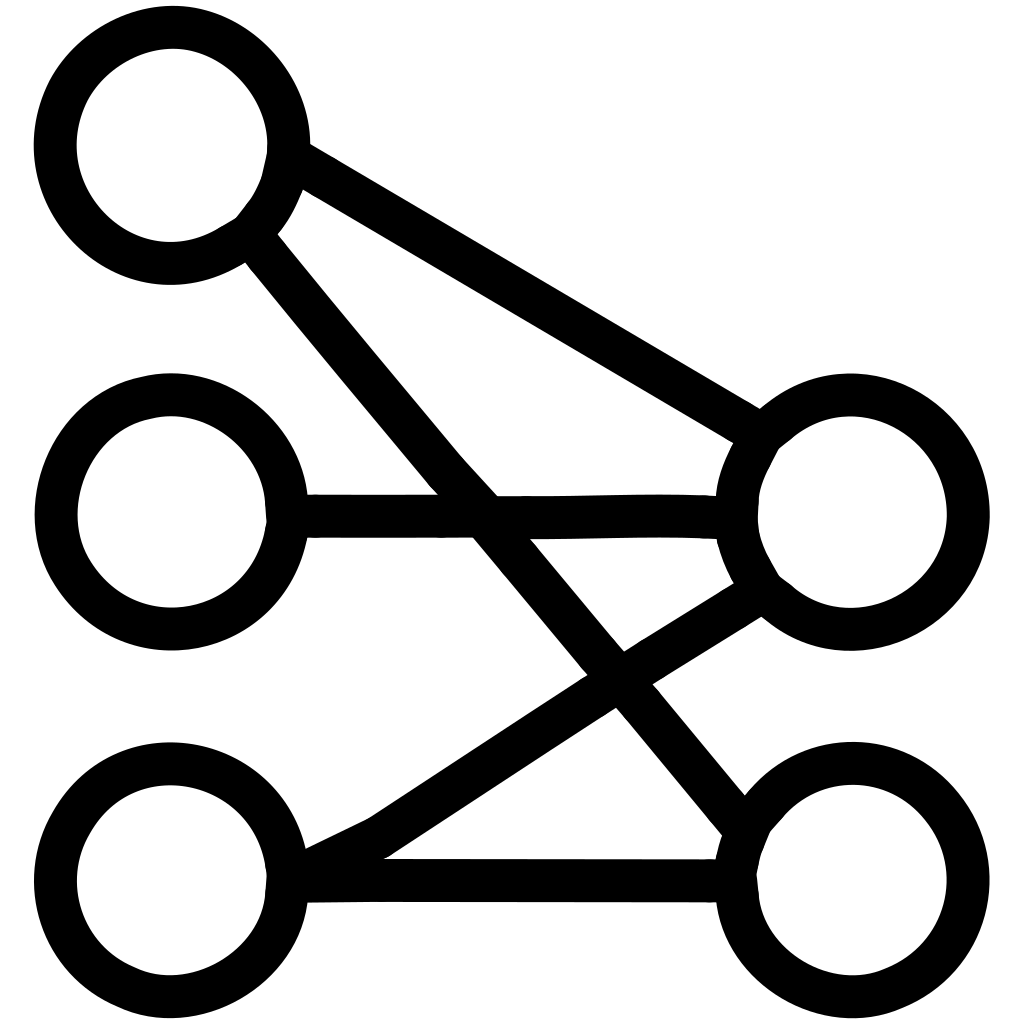
This closing note of the Advanced Deep Learning category covers Neural Architecture Search (NAS) — automating the process of designing a neural network's architecture itself, rather than relying purely on human intuition and manual experimentation.
The Core Idea
Every architecture covered throughout this hub — how many layers, what type of layer, how they connect — was, historically, designed by human researchers through intuition, experimentation, and iteration. NAS instead treats architecture design as a search problem: define a space of possible architectures, and use an automated search process to find one that performs well on a given task.
The Three Components of Any NAS System
| Component | Role |
|---|---|
| Search space | What architectural choices are even possible — which layer types, how many layers, what connections are allowed |
| Search strategy | How candidate architectures are proposed and explored — reinforcement learning, evolutionary algorithms, or gradient-based methods |
| Performance estimation | How a candidate architecture's quality is evaluated, ideally without the enormous cost of fully training every single candidate from scratch |
Three Common Search Strategies
- Reinforcement learning-based: a "controller" network learns to propose architectures, receiving a reward signal based on the proposed architecture's performance once trained — an application of the reinforcement learning ideas underlying RLHF from RLHF, applied here to architecture design instead of model behavior.
- Evolutionary algorithms: maintain a population of candidate architectures, repeatedly mutating and combining the best-performing ones across generations, similar in spirit to genetic algorithms in classical optimization.
- Gradient-based (e.g. DARTS): relax the discrete architecture search space into a continuous one, so architecture choices themselves can be optimized via standard gradient descent, alongside the network's weights — dramatically faster than fully training many discrete candidate architectures separately.
The Core Practical Challenge
Fully training and evaluating even one candidate architecture can take substantial time and compute — naively repeating this for thousands of candidate architectures is often prohibitively expensive. Much of NAS research specifically focuses on making performance estimation cheaper (e.g. training candidates for only a few epochs as a proxy, sharing weights across candidate architectures, or predicting performance without full training at all).
Code — A Conceptual Sketch
# A simplified NAS loop, conceptually
best_architecture, best_score = None, float('-inf')

for _ in range(num_search_iterations):
    candidate = search_strategy.propose_architecture(search_space)
    score = performance_estimator.evaluate(candidate)   # ideally a CHEAP proxy, not full training

    if score > best_score:
        best_architecture, best_score = candidate, score

# best_architecture is then typically trained fully, from scratch, as the final model
Common Mistakes
- Assuming NAS always produces meaningfully better architectures than skilled human design — for many well-studied tasks, hand-designed architectures (informed by the accumulated knowledge covered throughout this hub) remain highly competitive, and NAS's computational cost isn't always justified by the resulting gains.
- Underestimating NAS's own compute cost — even efficient NAS methods can require substantial resources, which is itself a real practical constraint on when NAS is worth applying.
Interview Relevance
Q: "What is the core practical challenge that most Neural Architecture Search research is trying to solve?" Fully training and evaluating even a single candidate architecture is expensive, and a search process might need to consider thousands of candidates — naively repeating full training for every candidate is often computationally prohibitive. Much of NAS research focuses specifically on cheaper performance-estimation strategies (proxy training, weight sharing across candidates, or gradient-based relaxation like DARTS) to make the overall search tractable.
Key Takeaways — Advanced Deep Learning
- Few-shot and zero-shot learning let models adapt to new tasks/classes from minimal or zero task-specific examples, either via in-context learning or specialized architectures.
- Meta-learning explicitly trains across many tasks to produce a good starting point for fast future adaptation; knowledge distillation transfers a large teacher's soft-label knowledge into a smaller student.
- Continual learning and federated learning both address training under real-world constraints — sequential tasks without forgetting, and decentralized, privacy-preserving data respectively.
- Multimodal learning and vision-language models (CLIP) jointly process and align multiple data types; Mixture of Experts decouples total model capacity from per-token compute cost; NAS automates architecture design itself.
Next: PyTorch shifts from concepts to hands-on implementation — tensors, autograd, nn.Module, DataLoader, and complete training loops, covering the practical framework mechanics used throughout every code example in this hub.
Practice Question
Why might gradient-based NAS methods like DARTS be significantly faster than reinforcement-learning-based NAS methods?
