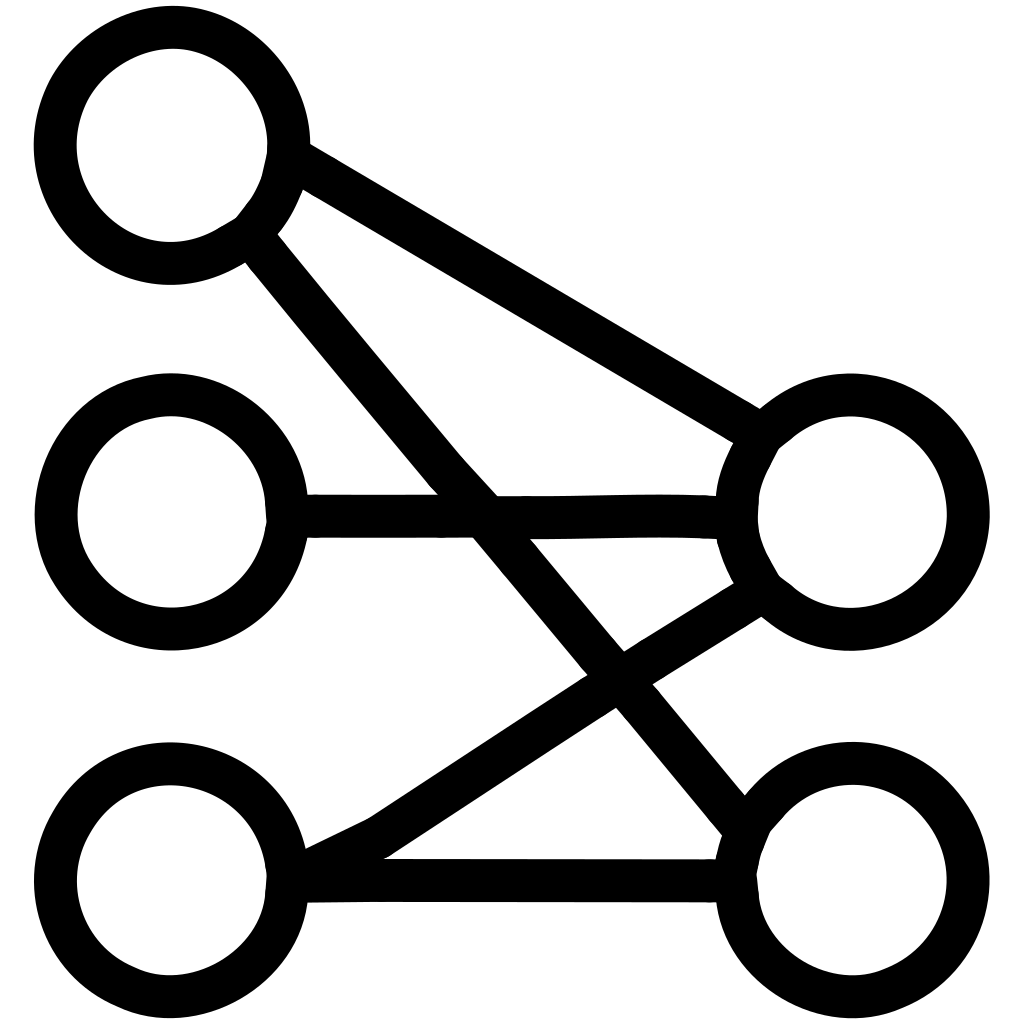
A neuron's receptive field is the region of the original input that can influence its activation — and understanding how this grows as layers stack is essential for understanding why deep CNNs can recognize large, complex objects despite each individual kernel being small.
The Core Idea
A single neuron in the very first convolutional layer has a receptive field exactly the size of its kernel (e.g. 3×3) — it only "sees" a 3×3 patch of the original image. But a neuron in the second layer, computed from a 3×3 patch of the first layer's output, indirectly depends on a larger region of the original input, since each of those first-layer values itself depended on its own 3×3 patch.
Formula for Receptive Field Growth
\(R_l\) is the receptive field size after layer \(l\), \(K_l\) is that layer's kernel size, and the product term accounts for how strides in earlier layers scale up the effective "step size" that later kernels take across the original input.
Numerical Example — Stacking 3×3 Kernels, Stride 1
| Layer | Receptive Field Growth |
|---|---|
| Layer 1 (3×3, stride 1) | 3×3 |
| Layer 2 (3×3, stride 1) | \(3+(3-1)\times1=5\) → 5×5 |
| Layer 3 (3×3, stride 1) | \(5+(3-1)\times1=7\) → 7×7 |
Stacking three 3×3 convolutional layers gives a neuron in the final layer a 7×7 receptive field on the original input — larger than any single kernel, built up entirely through depth. This is exactly why modern CNN architectures (see the CNN Architectures category) favor stacking many small kernels rather than using a few very large ones: it achieves large receptive fields with far fewer parameters (three 3×3 kernels have \(3\times9=27\) weights per channel vs. a single 7×7 kernel's 49) while adding more non-linear activations along the way.
Diagram
The deepest layer's neurons indirectly "see" a much larger region of the original input than any single layer's kernel size alone would suggest.
Common Mistakes
- Assuming a layer's receptive field equals just its own kernel size — that's only true for the very first layer; every subsequent layer's effective receptive field on the original input compounds across all earlier layers.
- Ignoring stride's multiplying effect on receptive field growth — a layer with stride 2 doubles the effective "step size" every subsequent layer's receptive field expands by, compounding significantly across a deep network.
Interview Relevance
Q: "Why do modern CNN architectures often stack several small 3×3 kernels instead of using one large 7×7 kernel?" Stacking three 3×3 convolutional layers achieves the same 7×7 effective receptive field as one large kernel, but with fewer total parameters (27 vs. 49 per channel) and — importantly — an additional non-linear activation function between each of the smaller layers, giving the network more representational flexibility for the same receptive field size.
Practice Question
Using the growth formula, what is the receptive field after two stacked 5×5 kernels, both with stride 1?
Related DL Notes
Want to go beyond the notes?
Join CodingNow 2.0's Deep Learning course — live mentorship, real projects, and 100% placement support.
Enroll Now — Free Demo Available